 |
Appendix-Page:
This page contains "more information" about sections in the HomePage and Models-Page.
iou – In the near future, March 4-11, I'll be adding more info to this page, along with some developing-and-revising that makes it easier to understand. Until then, just learn what you can or (probably wiser) come back later when it's better.
iou – Below, the gray-font paragraphs are just me "thinking out loud", i.e. the ideas will need significant re-writing (with developing & editing) to make them useful in this web-page.
I like the terms "proactive Problem Solving" (or "active Problem Solving") but I don't like "passive Problem Solving" because the process of "wise filtering" is a Mental Action (during the Evaluating in a Mental Experiment, then Comparing in a Quality Check) that results in a Non-Action by not actualizing (in a Physical Experiment) This Option for Physical Action.
"proactive" and "protective" have similarities-of-sound (with alliterative beginnings & same endings) that I like, but an Action seems "preventive" only if the Action prevents another person (or company, institution,...) from doing negative actions (like polluting); and this basically is proactive Problem Solving because you are doing positive Actions that help maintain quality (by preventing Actions-by-another that would make situation more-bad so the situation becomes less-bad when their Negative Actions are prevented by your Positive Actions). By contrast, does it seem strange to call self-control (by avoiding a Negative Action) a "Preventive Action" or "Preventive Strategy" or "preventive Problem Solving", or is this accurate and justifiable, and would it communicate with a fellow educator? (and "filtering" seems strange if it's to prevent Actions by another agent, another person or institution); Is "defensive" a more generally acceptable (and relevant) term, or does it have serious difficulties?
wise caution -- as in the art/skill of "not making things worse" or (in medical contexts) "first, do no harm"; or should we prioritize "first, do good" ?
When the Option is a Strategy (i.e. it's an Option-for-Action) the result of Evaluating this Option can be Strategic Action (when you decide to do the Action because your Evaluation leads you to conclude that it will be a beneficial Positive Action) or Strategic Non-Action (if Evaluation leads you to conclude that it would be a detrimental Negative Action).
Proactive Strategy or Defensive Strategy -- Proactive Problem Solving or Defensive Problem Solving.
evaluating an Option-for-Action with Risk-vs-Reward Analysis, or with Cost-vs-Benefit Analysis.
This definition is just a premise I'm assuming because I think it's educationally useful. {so it's trivially true? although pragmatically useful} If you agree about the practical utility, you can accept it.
But each "so" is based on evidence-and-logic (?) and can be challenged.
iou – Later (probably in May) I will discuss the research base for the claims made by How People Learn (and then by me) about transfer.
When doing research, one factor is the ease of gathering observations. It's "the lesson to learn" in an Aesop's Joke about a man searching for keys under a streetlamp, even though he lost them in a dark alley further down the street. In research about transfer, it's fairly easy to measure declarative knowledge (or conceptual knowledge) but this is more difficult for procedural knowledge. This is why standardized exams emphasize declarative knowledge rather than procedural knowledge.
Compared with transfers of procedural knowledge (as with Design Process), the evidence was stronger in 2000 (and in HPL) for transfers of declarative knowledge and conceptual knowledge. Since 2000, recent research-evidence and analytical comparisons (for all 3 types of knowledge) have strengthened the case for transfers of procedural knowlege, but still there is less evidence than for declarative knowledge and conceptual knowledge. But "absence of evidence" is not "evidence for absence," i.e. many more studies have been done for the other two transfers. I think the reality – not just what can justifiably be claimed based on evidence – is strong for transfers of procedural skills-knowledge. I think there are strong reasons to expect all three transfers to be increased by each of the three teaching methods, by using 2a or 2b or 2c, and is especially likely when using all of them, with 2a+2b+2c.
Later I will generate high-quality reports about this by using AI's (Claude & Perplexity, widely considered two of the best), and will comment on their findings. I think my overall conclusion will be that "yes, there is strong support for claiming the connection of 1a-1b-1c with 2a-2b-2c" and that it's especially strong for using Design Process (due to its key features, its two wide scopes and logical organization), compared with most other techniques for promoting metacognition.
4 Ways to USE Experiments (i.e. to USE Experiences)
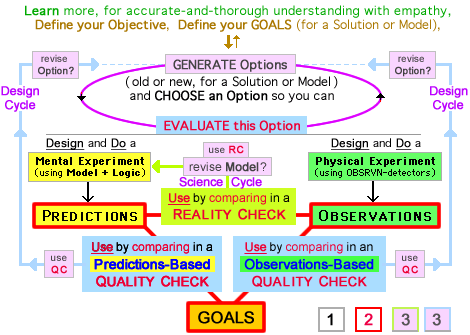
Design Process shows the central role of Experiments (Mental & Physical)* in problem solving, when you Design Experiments so you can...
1. USE an Experiment (Mental or Physical) to make Information (Predictions or Observations)
{ you “run” the experiment-situation mentally (by imagining it) or physically (by actualizing it) };
2. USE this Experimental Information to do Evaluation of an Option (e.g. of an Action, or...);
3. USE this Experiment-Based Evaluation to guide Generation of another Option.
* Mental & Physical EXPERIMENTS produce Mental & Physical EXPERIENCES , as explained above. { Information can be old and new, made by yourself & others }
Below, when a box (1 2 3 3) is activated – by touching it or moving your mouse over it – you can see four isolation diagrams that show only the problem-solving actions for Use #1 (make Information) and Use #2 (do Evaluation) and Uses #3 (guide Generation for Science-Design & General Design). {or you can see a larger diagram, but without mouse-overs}
|
In addition to 1 2 3, you can...
4. USE the Experiment-Based Evaluation (from #2 above) to guide Generation of more Information (in #1). This action is analogous to #3, except instead of Generating new Options (in #3) you are now (in #4) Generating new Information. How? You get new Information from new Experiments. First you ask “what additional Information (Predictions or Obervations) would be useful for Evaluation?” and then, in a question to stimulate ideas for Experimental Design, “what Experiments will produce this Information?” (in 1) that you can Use in 2 & 3.
The main reason that it's "most things we do" is because we design-and-use strategies many times every day, in many ways. In fact, you do this every time you make a decision. You can design...
• Action-Strategies for "doing it better the first time" with proactive Problem Solving,
• Thinking Strategies (using cognition-and-metacognition) that include Self-Regulated Learning, and
• Time-Strategies by asking “what is the best use of my time now? and later?” so you can wisely use your time, and – because “time is the stuff life is made of” (Ben Franklin) – you will wisely use your life.
Multiple Quality Checks ➞ Quality Status: In all stages of a progression for learning (here in 2, and in 1, 3, or 4) you use Quality Checks to estimate an overall Quality Status (that can range from low to high) for each of the Options being considered. How? You combine multiple Evaluations (old and new) from multiple Quality Checks (Prediction-Based & Observation-Based) that COMPARE many Predictions & Observations (from many Experiments) with many Goals — so “all things are considered” — for each competitive Option, in Evaluation that is Argumentation to help you make tough decisions about Choosing an Option. {Multiple Checks are used in General Design and Science-Design}
Creative Analysis: You can use analysis-and-revision (a thinking strategy to help you creatively Generate Options) by COMPARING the features/properties of an Option with Goals AND with other Options.
Multiple Iterative Cycles: When you're comparing many Options, your iterative Cycles of Design will involve many Options. But each cycle will feature only the Option you choose. In a series of cycles, you can focus on one Option for awhile, or shift your attention from one option to another.
Designing an Optimal Solution: When you have "many Goals" usually there is tough competition because different options offer different benefits, with some Options being better for some Goals (i.e. some Goal-criteria) but not other Goals. Therefore you must set priorities (by defining the importance of each Goal) and use trade-offs (by more effectively achieving some Goals at the expense of others) to design an optimal Solution that is best, when all things are considered, for achieving an overall combination of your prioritized Goals.
Using Multiple Checks in General Design and Science-Design: Section 3 compares General Design with Science-Design. For either kind of designing, you should use Multiple Checks – for Quality or with Reality – when it's possible. You can check for Quality (by using Quality Checks during General Design) and/or check with Reality (by using Reality Checks during Science-Design):
in General Design, you use multiple Quality Checks to estimate the Quality Status of all competitive Solution-Options, for many Quality-Factors;
in Science-Design, you use multiple Reality Checks to estimate the Predictive Accuracy of all competitive Model-Options, for many Experiments.
Making Decisions about Options: In a design project, solving a problem (in General Design) or answering a question (in Science-Design) requires decisions. Usually you do this by comparing the estimated Quality Status for Options – trying to optimize benefits and achieve Goals. You assign a Quality Status for each option by "combining evaluations from multiple Quality Checks... so all things are considered." Usually there is "a tough competition because several options offer different benefits... so you must set priorities... and use trade-offs... to design an optimal Solution" for achieving your prioritized Goals. {more about Determining Quality Status & Making Decisions; and much more about multiple Quality Checks that are done using multiple Goals & multiple Experiments & multiple Options} {a similar process-of-evaluation is done for Options [described here in Mode 3A] and for explanatory Models [described in Mode 3B], by using multiple Quality Checks to assign a Quality Status for each competitive Option, or using multiple Quality Checks (especially Reality Checks) to assign a Quality Status for each competitive Model}
Implementing (Actualizing) a Solution: After you decide that one Option is a satisfactory Solution, often this leads into another phase of the Design Project, when you Implement the Solution, i.e. you Actualize the Solution by converting it from a Potential Solution into an Actual Solution. For a product, implementing might occur in sub-projects to manufacture, market, distribute, and sell the Solution. { iou – This project-phase needs to be described more thoroughly, and for other kinds of options, which I'll do later. Here is an example of pursuing sub-objectives during a process of achieving an overall objective. }
Improving Understandings to Improve Transfers
Design Process can help students improve their transfers of ideas-and-skills (to improve their performance and/or learning) by helping them develop Conditional Knowledge (to improve their functional understandings of their ideas-and-skills) and organize Procedural Knowledge (to improve their conceptual understandings of their problem-solving process).
• develop Conditional Knowledge
A very useful kind of metacognitive knowledge is the Conditional Knowledge that is knowing WHAT you can accomplish with each skill (WHY to use it) plus WHEN to use it (the Conditions of Application) during a process of design. Each skill is a mode of thinking that is an option for “what to do next.” A better understanding of your skills, with conditional knowledge, will help you find a “WHAT-and-WHAT match” between WHAT will help you make progress (you know this with metacognitive awareness of “where you are now” and “where you want to go” in your process) and (by using Conditional Knowledge) WHAT you can do to make progress, so you can decide “WHAT to do next” in coordinating your process of design.
When you decide to intentionally learn for the future by improving your Conditional Knowledge for a variety of skills (that are useful in a variety of situations), this knowledge will help you remember/transfer your problem-solving skills, which will improve your problem-solving performance.
The structure of Design Process can help students develop Conditional Knowledge and also...
• organize Procedural Knowledge
Educational Benefits of Organizing: Research shows that logically organizing Conceptual Knowledge leads to better understanding, remembering-transfering, and applying. A logical organization of Procedural Knowledge, as in Design Process, should be similarly helpful for improving Conditional Knowledge (and thus Action-Coordinating Strategies) and in other ways. {some cognitive benefits of organization are illustrated by three quizzes, in which memory improves when 22 meaningless letters are organized into 6 meaningful words and then 1 interesting story} {instruction with verbal-and-visual integration}
Organizing to improve Transfer & Expertise: According to How People Learn, organization of knowledge improves transfer and expertise, including adaptive expertise that "is flexible and more adaptable to external demands," that uses metacognitive thinking strategies to cope with new situations, and pursues lifelong learning to continually improve ideas-and-skills. Regarding education, the authors wonder "whether some ways of organizing knowledge [and some kinds of learning experiences] are better at helping people remain flexible and adaptive to new situations." Maybe adaptive expertise can be promoted by teaching Design Process, which has a logically organized structure* and also (due to its options for “what to do next”) is flexible so it encourages structured improvisation.
* Organizing Knowledge with Design Process: The logically organized framework of Design Process — as in Diagram 3b` that shows, with spatial patterns and colors, the “parallels” of mental-and-physical experimenting used in Cycles of Generation-and-Evaluation (in two Design Cycles, one Science Cycle) — will help students understand the functional integration of problem-solving skills within each design experience, and also between design experiences in different subject areas to increase transfer between areas. Instruction that uses inquiry to teach inquiry probably will be very effective for learning and transfer. {more - other descriptions of verbal/visual integration in Design Process have more colorizing and more details}
a bonus: organizing most kinds of knowledge (not just Procedural Knowledge)* will help you improve your understandings and your transfers. {
The details-page has more about the benefits of organizing knowledge, including these principles from How People Learn:
transfer: Research shows that "organizing information into a conceptual framework allows for greater ‘transfer’; that is, it allows the student to apply what was learned in new situations and to learn related information more quickly." (HPL, page 17)
Expertise: "The sophisticated problem representations of experts [which improve their problem-solving abilities] are the result of well-organized knowledge structures. Experts know the conditions of applicability of their knowledge [they have high-quality Conditional Knowledge, and they are able to access the relevant knowledge with considerable ease." ..... One of HPL's three Key Findings is that "to develop competence in an area of inquiry, students must: (a) have a deep foundation of factual knowledge, (b) understand facts and ideas in the context of a conceptual framework, and (c) organize knowledge in ways that facilitate retrieval and application." (HPL, page 16)
more about reactive-proactive-protective / i don't know if "problem" has been explicitly defined as "any opportunity..." although this is implicit in the kinds of "problems" that are solved in many contexts & programs, using many different models.
|
using Science-Design iou – during late-March, I'll modify this section by adding sub-sections, and revising what is below.
Here are three contexts for using Science-Design: • during General Design: You use a functional Reality Check (in a functional check of a Theory that's being used to make Predictions) when you are "surprised" because Predictions are not matched by Observations, during a Project for General Design. • in Everyday Science: in a Project for Science-Design, when during everyday life a Theory is being Evaluated by a non-expert. Or in a classroom, when a teacher designs POE Activities so students can Predict-Observe-Explain and Learn. • in Research Science: in a Project for Science-Design, when a Theory is being Evaluated by experts. They... can work in academia or business; publish in research journals (for science or medicine); do Experiments and apply for research grants,... checking a Reality Check: In any context, instead of responding to a failed Reality Check (with Predictions ≠ Observations) by simply concluding “the theory is wrong” you can examine each thing that's involved in the Reality Check, because the lack of close matching could be due to errors in... • the Predictions (in the Inductive Logic or Deductive Logic); • the Observations (in Designing the Experiment, Doing the Experiment, or Making Observations); • the logic of comparing Predictions with Observations; • the Main Theory (used to make Predictions) or Supplementary Theories (that also are used). All of these possibilities can be considered when you ask “why was the matching not closer?”
ws.htm#trlife --- Students use scientific reasoning often in life, whenever they hear a claim and ask “what is the evidence-and-logic supporting this claim?” In all areas of life, they can use Science to improve their Theories about “how the world works” and improve the accuracy of their Predictions about “what will happen.” And they can develop a logically appropriate humility – with justifiable confidence that is not too little, and not too much – when estimating the plausibility status of claims for truth claims for truth that are made by themselves and by others. In these three ways, their better understandings will help them make wise decisions while pursuing their goals in life. [[claims - hear or make]] website.htm#trlife --- Transfer of Science-Skills into Life: In all of life (not just in science) we use our personal theories about “how the world works” to understand “what is happening” and to imagine “what will happen” when we make predictions that, along with our values & priorities, can help us make wise decisions, personally and professionally, to help us achieve our goals in life. In all areas of life we use the logic of science (to evaluate, infer, persuade) whenever someone makes a claim and we ask “what is the evidence-and-logic supporting this claim?” Teachers can use this wide scope by combining Scientific Logic with generalized Critical Thinking in activities that include lively debates and analysis of Logical Fallacies. This is one way to motivate a wider range of students so they will want to improve their skills with the Design Thinking they use for all kinds of STEM/STEAM Education and beyond, because critical evaluation of ideas is essential for skillful reading/writing & listening/speaking, and thus for many of the worthy educational goals in Common Core and Next Generation Science Standards. Appropriate Humility, to Avoid Two Errors: Improved scientific reasoning will promote the logically appropriate humility (with a confidence that is not too little, not too much) described by Bertrand Russell: "Error is not only the absolute error of believing what is false, but also the quantitative error of believing more or less strongly than is warranted by the degree of credibility properly attaching to the proposition believed, in relation to the believer's knowledge." An appropriate humility will help us avoid 2 of these 3 kinds of error. {Accurate Understanding - thus appropriate humility? - and Respectful Attitudes} {The Rationality-and-Idiocy of Postmodernism} {a revised-and-condensed version of Education to Prepare for Life with Transfer of Skills into Life when students improve their skills of creative-and-critical productive thinking that can be improved by using a wide variety of Strategies for Thinking taught using Strategies for Teaching} |
a better explanatory theory to answer questions about “how things work in the world” and thus “what happens & why it happens” to help us understand the how-what-why of reality.
@ da-ur (Understanding & Respect)
but this can lead to AD HOC Theory-Revisions, rationalizing to ignore an unwanted failed Reality Check
• psychology: wanting to reduce the unpleasant cognitive dissonance they feel when they recognize an inconsistency between two personal theories, or two personal actions, or a theory and action. reduce our cognitive dissonance.
• sociology: wanting to maintain their status (or improve it) within a personally-important group, if almost all group members believe a Theory; in this context, they are motivated to also believe this Theory (for loyalty signaling that is virtue signaling?) to retain current allies or gain new allies, to "win victories for us" in battles of us-against-them. (@da-ur.htm#mr)
Evaluation Criteria that can be Goals for the desired characteristics of a satisfactory Theory. / @my PhD work, ISM with three kinds of — Empirical Factors (in Reality Checks), Cultural-Personal Factors (e.g. the psychological & sociological factors above in Everyday Science; these also occur in Professional Science, plus others, e.g. getting funding for research grants, getting publications in research journals & getting tenure; for these, just @ws.htm#sp and sp-cr.htm)
[ use in #m3a2 ? --- Science-during-Design: Design Process accurately describes the common way we use science-and-design together. Our everyday “science during life” is naturally explained by the integrative structure of Design Process because the central core of its evaluative logic (when 3 Elements are used in 3 Comparisons) shows the way we naturally do both General Design (aka Design, the usual term) and Science-Design (aka Science, usually) together. By contrast, most other models-for-process describe a process of either Design or Science, but not both. The smooth integrating of Design-AND-Science (in Design Process) will help students develop a smooth integrating of Design-AND-Science (in their thinking) while they are solving problems.
{ Why do we use Reality Checks most often during General Design for a Reality Question, not during Science-Design for a Science Question? }
ask "revise Theory?" in a Science Cycle by using Guided Generation that in Science is Retroductive Generation.
iou – many kinds of science: @ws#trsci-->h#trsci(sci-vs-Sci); here it's best to imagine it's for your use • during General Design (RC to Check own T used to make Predns); to check T's of Science (in School, in Profession); to Check T's in everyday life