options: You can read any section (below) whenever you want, in any order. { although I recommend that you first get a “big-picture overview” by reading all sections in the shorter Summary }
In the HomePage,
Part 1 helps you understand my model for problem-solving Design Process.
Part 2 explains how this model can help us achieve worthy educational goals.
Basically, Part 1 is the “what” of my model, then Part 2 answers the “so what ?” about educational benefits.
To explain how using Design Process can help us produce educational benefits, Part 2 describes three claims (in Sections A-B-C) and explains the causal connections between these claims:
Wide Scopes of Design Process (for Activities and Process) { A }
➞ Transfers of Learning (Across Areas, Through Time) { in B }
➞ Transfer Bridges to Motivate for Personal Education { in C }.
Part 2 – Educational Benefits
Section A — Wide Scopes and Educational Benefits
This section has three sub-sections, to explain why Design Process... A1) has a Wide Scope for Process, A2) has a Wide Scope for Activities, A3) can be educationally beneficial with two main benefits, by helping students learn more (this is examined in A3) and (described in B & C) by producing Transfers of Learning that will help students be more motivated.
There is one Wide Scope (for Activities-and-Process) but sometimes it's useful to think “it has two Wide Scopes, for Activities and for Process” so that's what I'll do in most of A1 and A2. (and later in B)
A1 – Design Process has a Wide Scope for Process
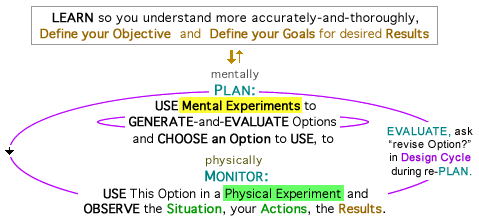
An Actions Diagram shows how Design Process uses action-verbs (Define, Generate, Evaluate, Choose, imagine-to-Predict, actualize-and-Observe, compare) to describe the basic Problem-Solving Actions that people actually do while we're Solving Problems. This gives the model a modular structure and a modular flexibility that lets us combine these simple Thinking Actions to do a wide variety of complex Thinking Projects (with Process that is similar but not identical), often by combining some Actions into Action-Sequences. By analogy, it's like combining simple Lego Bricks to construct complex Lego Structures; or how simple atoms combine to form complex molecules. { The analogy works well because action-verbs and Lego Bricks both produce a modular structure that allows modular flexibility. } And...
You can get personal “anecdotal evidence” for a Wide Scope that includes Your PS-Actions when you do Recognition Learning by "thinking about the actions you use (naturally & intuitively) while you are solving problems" and recognizing that Your PS-Actions in Everyday Life are The PS-Actions in Design Process so Your Personal Process is a General Process (with Wide Scope) that is Design Process.
Even though I'm confident that using Design Process can be educationally valuable, its utility is limited by an important reality: all models-for-process have an inherent limitation, because it's impossible to construct any model that is an optimal “best process” for all Problem-Situations. Therefore a very useful teaching strategy is recognizing that ...
By itself, sometimes Design Process isn't sufficient for an optimal Problem-Solving Process — for a “best Process that produces a best Solution” — so my model should be combined with other models. For some Problems it's useful to supplement the principles & strategies of Design Process with the principles & strategies of other Models-for-Process. We can combine models effectively because the modular structure of Design Process forms a foundation that is solid yet flexible so it can “play well” with other models, producing interactions that are synergistically supportive, that make the combination of models better than any single model by itself, to improve Education (by teachers) and Problem Solving (by students). { exploring the possibilities for productively combining models can be an exciting part of “thinking adventures” in Section C }
|
iou – during mid-August the ideas in this “brown box” will be developed-and-revised (and then moved out of the box) to describe strategies for optimizing your “whole-brain system” that combines subconscious processing with conscious thinking. Here are some of the ideas (condensed from the HomePage) that I'll use: [ available August 9 ] — One set of ideas will be the conscious "Executive Functions" that help us optimize our "system" with metacognitive Self-Regulation.
|
A2 – Design Process has a Wide Scope for Activities
Why? It's partly because choosing a broad definition for problem – as any opportunity to make something better, in any area of life – produces a Wide Scope. / But this definition can be used with many other Models for Problem Solving, so they also can have a Wide Scope for PS-Activities. It's much more important for a model to have a Wide Scope for PS-Process. And as explained in A1, Design Process does accurately describe the General Process that is used by most people for most things we do throughout the Wide Scope of our PS-Activities, so the model has a Wide Scope for Activities-and-Process.
What? You decide to do a Problem-Solving Activity when (quoting from an Overview-Diagram) you "Define a Problem-Solving Goal (for What to Achieve, for What to Make Better). Your choice can be in...
five categories of PS-Activities: When you Define your PS-Goal (and thus a PS-Activity) you can choose to design a better product, activity, relationship, and/or strategy (in General Design, aka Design) and/or (in Science-Design, aka Science) a better theory about “how things work in the world” and “what will happen.” These PS-Goals – extending far beyond traditional “design fields” – include most things you do in life. / The main reason I confidently claim "most things" is because you use strategies MANY times each day; two common examples are using Self-Regulated Learning and making decisions, most often by asking Time Questions (“what is the best use of my time right now? and later?”) so you can wisely use your time, and — because “time is the stuff life is made of ” (Ben Franklin) — you will wisely use your life.
other ways to categorize: A teacher may want to define another set of categories, customized so it's a better fit with their students. A teacher wants the categories (for PS-Goals) to closely match the life-experiences of students, so they are more likely to recognize the personal relevance of School Activities and be motivated by expecting that “my learning in School-Life will improve my Whole-Life (and I want this), so I want to proactively pursue my own Personal Education in School-Life.”
Despite a common perception, a “problem” doesn't necessarily begin with a bad situation. When we broadly define a problem as "any opportunity to make something better," the change could be from miserable to adequate, or from pleasant to wonderful. Each of these is problem solving because things have become better.
Another way to think about the Wide Scopes of Problem Solving is to recognize that you can "make something better" if ...
with reactive Problem Solving you “make it better” by improving it (to fix it) after it already exists, or
with proactive Problem Solving you “do it better” the first time, so there is less need to "fix it" with reactive improving. { This is the “measure twice, cut once” of carpenters, to take advantage of your only opportunity to make a high-quality first cut. }
You also can make things better — by increasing quality or maintaining quality (by minimizing a decrease of quality) — when...
with proactive Problem Solving you do positive Actions that (because they are done) will produce beneficial effects, and
with protective Problem Solving you avoid negative Actions that (if they were done) would produce detrimental effects.
And you can do all of these with your subconscious processing and/or your conscious thinking.
A3 – Educational Benefits
iou – Soon, August 4-7, I will write this section. More than any other incomplete “iou section” it will describe important ideas — including
the benefits of combining Design Process with other Models-for-Process because "it's impossible to construct any model [including Design Process] that is an optimal “best process” for all Problem-Situations" so "in some Problem-Situations it's educationally useful to supplement the principles & strategies of Design Process with the principles & strategies of other Models-for-Process," These combination can be an exciting part of Adventures with Thinking.
teaching Design Process with a sequence of Experiences + Reflections ➞ Principles — and it will link to other sections (in this Basic Overview) with other important ideas about Educational Benefits.
B – The Wide Scopes increase Transfers of Learning.
Design Process (DP) has two Wide Scopes and is logically organized.
These three characteristics of DP let us teach its procedural knowledge (for the skills of Solving Problems, of Designing Solutions to Make Things Better) in ways that will increase Transfers of Learning,* both Across Areas (in School & in Life) and Through Time (Past ➞ Present ➞ Future).
How? Transfers increase when we teach the procedural knowledge...
• in multiple contexts (allowed by DP's Wide Scope for Activities)
• in a generalized form (allowed by DP's Wide Scope for Process),
• for deep understanding (promoted by DP's logically organized verbal-and-visual framework).
* We have reasons to be confident — due to evidence-based research and common-sense logic — that these “ways to teach” will increase Transfers of Learning and will be useful for a Goal-Directed Designing of Curriculum & Instruction when we Define Goals for a Curriculum and Design Instruction to achieve these Goals. { iou – the Expanded Overview will describe one source for the
C – Transfers help students build Motivational Transfer-Bridges.
We can motivate with Bridges plus Metaphors & Adventures.
When we explain how the Wide Scopes of Design Process let us use methods of teaching that (as described in B) increase Transfers of Learning, we can help students expect Transfers to occur Across Areas (from School-Life into Their Whole-Life) and Through Time (from Past to Present and into Their Future). They will think “Learning in School is Learning for Life” and they will build Transfer-Bridges that motivate them to invest effort in proactively pursuing their own Personal Education. Why? Because they believe that improving their School Learning will improve their Life Living. [ iou – July 17, I'll add a few more ideas to this section. ]
More generally, we can help students motivate themselves with...
Bridges for Transfers of Learning-and-Performing from School into Their Whole-Life and into Their Future-Life.
Metaphors about Thinking, by explaining how to metacognitively “Drive Your Brain” — and use your Growth Mindset to imagine how exciting it will be when you increase its Performance (like a car's Horsepower & Torque, DriveTrain, Handling Characteristics)* — and “Be CEO of Your Thinking” by using your Executive Functions to optimize your Whole-Brain System of Subconscious Processing + Conscious Thinking. { use analogies: Horsepower & Brainpower, Car-Performance & Brain-Performance; Growth Mindset-plus-Actions for Muscles & Brain } [ iou – Later there will be "more" in the Expanded Overview. ]
Adventures in Thinking, by inviting them to explore the fascinating world of thinking when they LEARN Thinking Strategies (for effective Cognition-and-Metacognition) and USE Thinking Strategies. { iou – This is the section that I'm most excited about developing during July, especially by exploring possibilities for understanding cognition-and-metacognition and for combining Design Process with other Models-for-Process. }
Part 2 has some sections (A-B-C above) that directly involve Design Process, and others (below) that are General Principles of Education.
Principles for Motivating Students: [ iou – I'll develop this later, during July 17-21. ]
Growth Mindset
A student is responding with an optimistic growth mindset – not a fixed mindset – if they ask themself “how well am I doing in this area of life?” and honestly answer “not well enough” BUT they are thinking “not yet” (instead of “not ever”) because they expect that in this area* they can “grow” and improve their abilities, when they invest intelligent effort. As one way to promote this realistic-and-optimistic view of self, a teacher can explain how a student's "intelligent effort" can include cognitive & metacognitive Thinking Strategies that they now can use more often (and more effectively) than they did in the past, and these strategies will help their future abilities “grow” beyond their past abilities.
* It's "in this area" because a student's attitudes will vary from one area to another, re: their expectations for personal growth. Ideally a student will develop-and-use a growth mindset in all areas of their life, because...
As you know, promoting a productive growth mindset is one of the best things a teacher can do for their students, to help them thrive in school and in life.
Learning that improves Performing
When you want your best possible Performing Now, you have a Performance Goal. When you want your best possible Learning Now so you can improve your best possible Performing Later, you have a Learning Goal. Or you can want some of both, with a combination of Performing-and-Learning. { For example, compare the main goals for a basketball team during an early-season practice and late-season tournament game. } { more }
Differences in Goals — whether you want best Learning Now and/or best Performing Now — will affect strategies (of students & teachers) in ways that are important and complex.
iou – during July 17-21, I will condense sections in the HomePage to make the following sections for this Basic Overview and the Expanded Overview:
Three Kinds of Improvising – for problem solving, conversation, music
Goal-Directed Designing of Curriculum & Instruction for Optimal Whole-Person Education that helps us improve Diversity & Equity in Education to “open up the options” for all students, so each will say “yes, I can do this” for a wider variety of subject-options in school and career-options in life.
iou – during mid-August, I will write a brief “conclusion” for this Basic Overview.
|
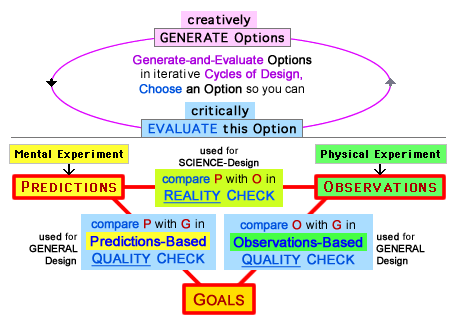 This “miniature HomePage” is written for fellow educators, to help you learn on three levels:
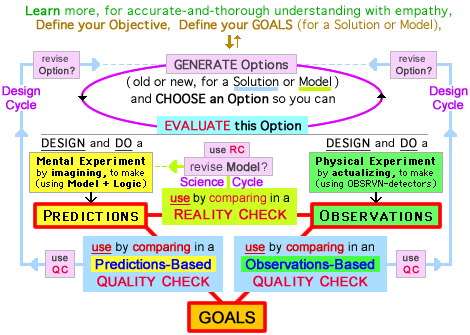 To confirm this Recognition Learning, study the Complete Diagram (put it on left side with